Texas is still growing faster than most of the country, but 2026 has turned into a year of moderation rather than a repeat of the boom years that followed the pandemic.
The clearest signal comes from the Federal Reserve Bank of Dallas, which built its 2026 Texas Employment Forecast around GDP projections, oil futures, and the state’s own leading economic indicators. The bank’s report points to statewide employment growth of about 1.9% for the year, though Dallas Fed senior business economist Luis Torres has said actual growth is likely to land closer to the low end of that range. Torres pointed to a mix of headwinds behind the more cautious outlook: slower immigration limiting the labor supply, rising productivity reducing the need for new hires, cooling business-outlook surveys, and ongoing geopolitical uncertainty tied to tariff policy.
That’s a real shift from the tone of state economic messaging at the start of the year. Governor Greg Abbott’s office used its January recap to tout Texas’s 21st consecutive year as Chief Executive magazine’s top state for business, along with a series of high-profile wins: a new Texas Instruments semiconductor wafer fabrication plant in Sherman, and a $40 billion commitment from Google to expand cloud and AI infrastructure in the state — reportedly the company’s largest single-state investment to date, according to figures the Texas Workforce Commission cited in its January newsletter.
Site-selection activity has kept up that pace through the year. Business Facilities magazine has tracked a steady stream of relocations and expansions, including a $6.5 billion Eli Lilly manufacturing expansion in Harris County expected to create more than 600 jobs, a new Scotiabank regional hub in Dallas backed by roughly $60 million in investment and over 1,000 new positions, and a first U.S. plant for Quebec-based plastics maker Lefko in New Braunfels.
Infrastructure spending is following the same trajectory. The Texas Department of Transportation’s 2026 Unified Transportation Program lays out $146 billion in planned statewide improvements, and Port Freeport has continued expanding capacity to handle growing freight volumes along the Gulf Coast.
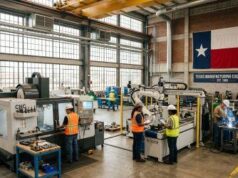
What it means locally: for Texas job seekers and small-business owners, a 1.1%–2.7% statewide growth band still points to more hiring than most states will see this year — just don’t expect the double-digit corporate relocation headlines of 2021–2023 to repeat at the same clip. Employers in manufacturing, logistics, and data-center-adjacent industries appear best positioned to keep adding jobs through the rest of 2026.
Sources: Dallas Federal Reserve Texas Employment Forecast (via Must Read Texas); Texas Workforce Commission, Texas Business Today, January 2026; Business Facilities magazine, Texas coverage.