A Problem Automation Keeps Underestimating
Every few years, some new bonding technology gets billed as the thing that will finally make the sewing machine obsolete. Ultrasonic welding was going to do it. Then heat-sealed tape. Then structural adhesives borrowed from aerospace. And yet walk onto the floor of a parachute loft, an airbag plant, a bootmaker’s workshop, or a sailmaker’s loft today, and you’ll find rows of industrial sewing machines running exactly as they have for decades — just faster, quieter, and computer-controlled. The reason isn’t tradition. It’s that stitching solves a problem almost nothing else can: joining soft, flexible, deformable material without turning it into something stiff, brittle, or sealed shut.
This article looks at why that problem is so hard to solve any other way, which industries still can’t do without a needle and thread, and how industrial sewing machine equipment supplierssuch as Atlanta Attachment Co.have built an entire ecosystem of specialized machine attachments to make industrial sewing fast, precise, and repeatable at scale.
Why Flexible Materials Resist Every Other Joining Method
Rigid manufacturing has plenty of joining options: welding, riveting, bolting, brazing. All of them assume the material being joined holds its shape. Textiles, leathers, and technical fabrics don’t. They stretch, shift, fray, and drape unpredictably, which immediately rules out most rigid-part logic.
Adhesives soak into woven fibers unevenly and stiffen the fabric at the bond line. Heat welding only works on compatible thermoplastics, so a cotton-poly blend or a natural fiber is often a non-starter. Both methods also tend to fail suddenly: once the bond’s peel or shear limit is reached, it releases all at once. A sewn seam behaves completely differently — individual stitches give way one at a time under excess load, which acts almost like a mechanical fuse. In products where a sudden, total seam failure could be dangerous, that gradual failure mode isn’t a side benefit; it’s the entire point of the design.
Where Sewing Refuses to Be Replaced
Parachutes and safety harnesses. Canopy panels are joined with multiple redundant rows of stitching specifically because engineers want the seam to shed load thread by thread rather than release all at once mid-descent.
Automotive airbags and seatbelt webbing. These seams have to survive an explosive deployment measured in milliseconds, then hold their shape reliably enough that the bag inflates in a controlled, predictable pattern instead of tearing open randomly.
Footwear and leather goods. Welted and stitched shoe construction remains the gold standard for durability and resolability, since a stitched shoe can be taken apart and rebuilt, while a cemented one usually can’t.
Marine sailcloth and heavy tarpaulins. These fabrics flex constantly in wind and sun for years. A stitched seam distributes that repeated stress across many small mechanical points rather than one continuous adhesive line that can peel or crack with UV exposure.
Medical textiles and PPE. Gowns, drapes, and compression garments need seams that flex with the body and don’t create an impermeable, non-breathable barrier the way heat-sealing does.
Upholstery and vehicle interiors. Seat covers and trim panels need seams engineered for exact, repeatable strength, since a weak seam under constant sitting and flexing pressure will eventually blow out — but a needlessly over-built one wastes material and adds bulk.
The Real Engine Room: Specialized Attachments
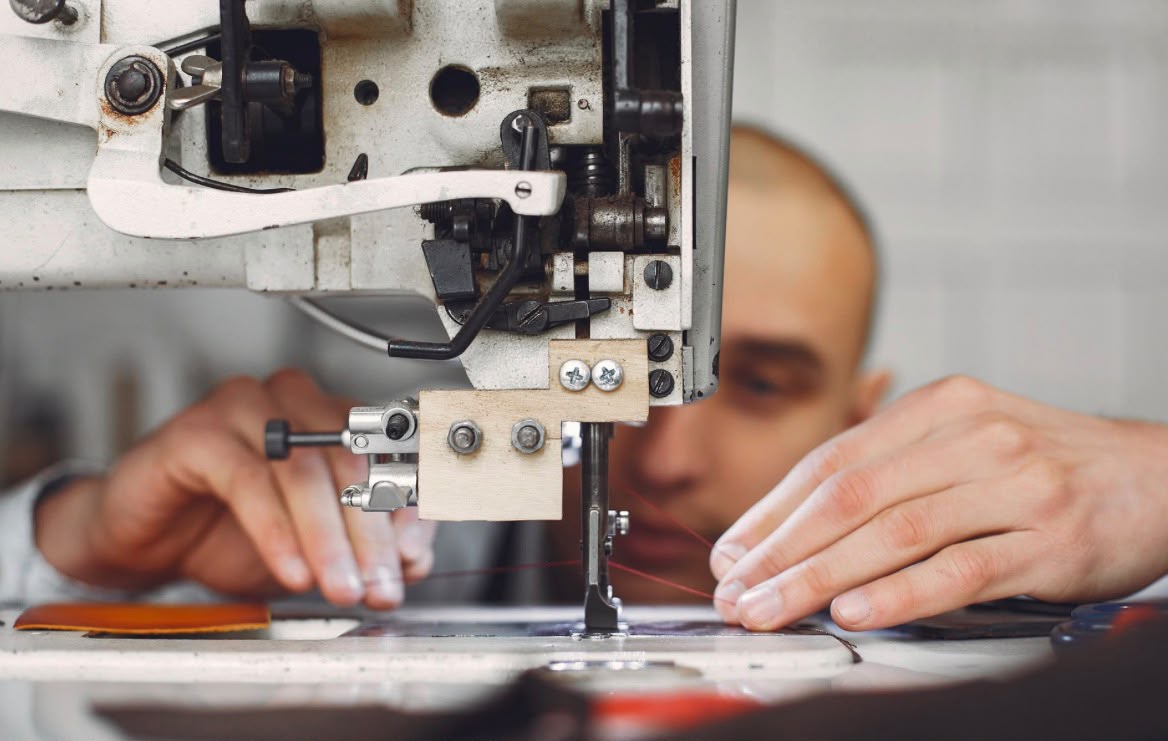
What often goes unnoticed outside the industry is that a base industrial sewing machine is really a platform — most of its versatility comes from swappable attachments and specialized presser feet engineered for one job apiece. These attachments are why the same core sewing mechanism, largely unchanged since the mid-1800s, can handle everything from delicate silk to multi-layer ballistic nylon.
- Walking foot (compound feed foot): Moves the top and bottom fabric layers in sync with the feed dog, preventing slippage between layers. Essential for slick or multi-layered materials like leather, vinyl, or laminated fabrics that would otherwise shift and pucker.
- Roller foot: Uses small rollers instead of a flat sole plate to reduce friction, letting the machine glide over materials such as suede, patent leather, or coated fabrics without dragging or marking the surface.
- Zipper foot: Narrow and offset to one side, allowing the needle to stitch directly alongside a zipper’s teeth or a raised trim without the foot colliding with it.
- Binding attachment (binder foot): Automatically folds bias tape or binding strip around a raw fabric edge as it feeds through, encasing and finishing the edge in a single pass instead of requiring a separate folding step.
- Edge guide and seam guide attachments: Bolt onto the machine bed to keep every seam a fixed, consistent distance from the fabric edge, critical for high-volume runs where seam placement has to match across thousands of identical pieces.
- Piping/cording foot: Has a grooved underside that cradles pre-made piping or cord, letting it be sewn neatly into a seam line for upholstery and cushion work.
- Ruffler attachment: Mechanically gathers or pleats fabric as it feeds through, automating a task — even gathering — that would otherwise require painstaking manual pinning and adjustment.
- Bar-tacking and pattern-tacking attachments (or dedicated bar-tack machines): Stitch small, dense reinforcement blocks at stress points like pocket corners, belt loops, or airbag seam ends, dramatically increasing local seam strength exactly where it’s needed.
- Needle-feed and puller attachments: On heavy-duty machines, these help move thick, multi-layer material (canvas, upholstery leather, technical textiles) through evenly, since gravity and friction alone would otherwise cause uneven stitch length on dense material.
- Automated pattern-sewing jigs and templates: Hold a cut piece in a fixed shape while the machine head follows a programmed path, used heavily in airbag manufacturing and automotive trim, where seam geometry must be identical across every unit.
This modularity is part of why sewing survives as a manufacturing method: a single machine platform can be reconfigured with different feet and guides to handle an enormous range of materials and stitch geometries, rather than requiring a completely different machine for every new product.
Automation’s Real Bottleneck Isn’t the Stitch
It’s worth being precise about what automation has and hasn’t solved here. Computerized, servo-driven sewing heads have existed for years and handle needle position, tension, and stitch programming with excellent consistency. The unsolved problem is upstream of the needle: handling limp, deformable fabric reliably enough for a robot to feed it the way a human operator does almost without thinking. Vision-guided alignment systems and soft robotic grippers are slowly closing that gap, but full unattended sewing automation for anything beyond flat, simple, repeatable seams remains a hard engineering problem — which is exactly why skilled machine operators, not robots, still run most sewing floors today.
When Other Methods Make More Sense
Sewing isn’t always the right call. Fully waterproof garments often use heat-sealed or taped seams to avoid needle holes altogether. High-volume single-material thermoplastic products, like some disposable medical items, can be ultrasonically welded faster than they could ever be stitched. And some fashion and performance sportswear brands deliberately bond seams for a smooth, stitch-free look. In practice, a lot of finished products are hybrids, using sewing where flexibility and repairability matter most, and bonding or welding elsewhere to seal, waterproof, or simplify.
Conclusion
Industrial sewing survives in modern manufacturing because it does something no rigid-part joining method can: hold flexible material together without stealing its flexibility, and fail gracefully instead of catastrophically when pushed past its limits. The machines themselves have modernized considerably, but their durability as a manufacturing choice comes just as much from the enormous library of task-specific attachments built around them — walking feet, binders, rufflers, bar-tackers, and pattern jigs — that let one basic mechanism adapt to nearly any material or seam a product designer can dream up. That combination of mechanical principle and mechanical adaptability is a hard thing for any newer technology to fully replace.